Showing posts with label Anancy. Show all posts

Saturday, January 17, 2015

To be, or not to be . . .quaint: the back story


I’ve been meaning to write a blog about what Caribbean children’s literature is, or should be, or can be.  And yesterday I got a phone call which gave me new insight and made me realize that I could not put it off any longer.

When I run writing workshops, I always  point out to the participants that the target audience is a key aspect of writing. This usually applies to the differences in the  level of the material, the mechanics of writing  and perceived interests of the target audience. Essentially the writer can jump in passionately and write whatever catches his/ her fancy, but at some point, and usually this is before starting to write, the writer has to decide if the story is going to be in picture book/picture storybook format, or a chapter book or a young adult novel. The story the author wants  to tell often dictates the level. Most authors tend to write for a particular target audience; some can write for various levels. This would apply across the world of children’s’ writing.

We are all accustomed to European/Western children’s literature. For some decades now, however, developing countries/ex European colonies  have been trying to develop their own children’s literature, based on the psychological construct that seeing oneself in books and reading about one's own cultural environment contributes to a healthy self concept. One might ask if the reverse is therefore true.

It would seem that the rationale for producing local children’s literature must have been accepted by the people of the Caribbean by now. I and others have been on this bandwagon for the last 30  years at least; the Doctor Bird Reading Series, supplementary readers developed by the Ministry of Education here in Jamaica in the early 1980s, and for which I wrote, were to address this very need. The Jamaica Reading Association had already done some local short stories, and the Children’s Writers Circle sought to continue this by encouraging local writers to produce material. There were other authors in the Caribbean with the same dream; and we even formed regional authors’ groups. We achieved a lot; the Jamaica Library Service was supportive. Oh how confident we were! However, perhaps it wasn’t a bandwagon, but more like one of those old-time drays pulled by mules or  oxen, to be overtaken by. . . time . . . and . . . the excitement of technology.

Everyone gives lip service to the support for local children’s literature. However, although we  have a new generation of young publishers in Jamaica and the rest of the region, they seem to be facing the same frustrations we eventually did.

So what do we say are the challenges again?

1.       Low purchasing power/disposable income

2.       Small overall market in the region, hence low print runs, hence high unit costs, in the face of much cheaper foreign books

3.       Socialization to foreign children’s books, which traditionally were what we all read. So today, even the gatekeepers, who should welcome local books, cannot find it in their hearts or minds to purchase local/regional material.  Have we all been colonized, even those who were never governed or taught by overseas people? 

I am becoming convinced that this might not change much, ever.

However, what about the target audience? What part do they play? What does the target audience want? And who are they anyway?

Most of us writers have been writing what we consider to be contemporary Caribbean children’s literature for our children, so that they can know that they are important enough to be in books. In this endeavor, we have tried not to be too quaint. For the purposes of this  discussion, a definition of quaint might be ‘attractively unusual or old-fashioned’.  After all, our present-day children aren’t quaint; they live in a real world where there are computers, tablets and smart phones. Even if some of them don’t have these items personally, they interact with them in school. They face  very real lives with modern challenges. I think many of us find that our stories consist of the reality of today’s world set in an environment, which though it may have aspects of the quaint, this quaint is not for the sake of quaint, but only as it supports the setting of the story.  

We are convinced that our children want and should have contemporary stories and characters with contemporary concerns.

But are our children the target audience?

Or are the gatekeepers the real target audience, and are they a little bit afraid of what contemporary might mean, without sometimes actually reading the books?

And what of the overseas target audience, the diaspora about which we dream? ( “If this book could just get to the diaspora, man, I cool.”)

So yesterday when someone asked me how to find a book for a relative overseas to give to a child; ‘something like Anancy’, I replied, “Ah, - like folktales?” “Yes”  was the relieved reply.

And what is more quaint than Anancy and folktales? And when you are overseas, what is more nostalgic and suitable for young relatives divorced from this their ‘ancestral home’ than Anancy and folktales and quaint? And truly, I cannot argue with that. I’m sure that all displaced people, whether displaced willingly or not, long for that security of memory  -  made more delightful with passing years and distance -  of the quaint. The diaspora is probably not longing to read about contemporary children. And even if we consider the multicultural overseas markets, even if we could access it, I bet you they will just want the quaint. 


Please join the conversation.  In a future post I’ll look at some books by title, including the recent YA Burt Awards, which represent our latest regional achievements.


Sunday, September 7, 2014

Whose folktale is it anyway?


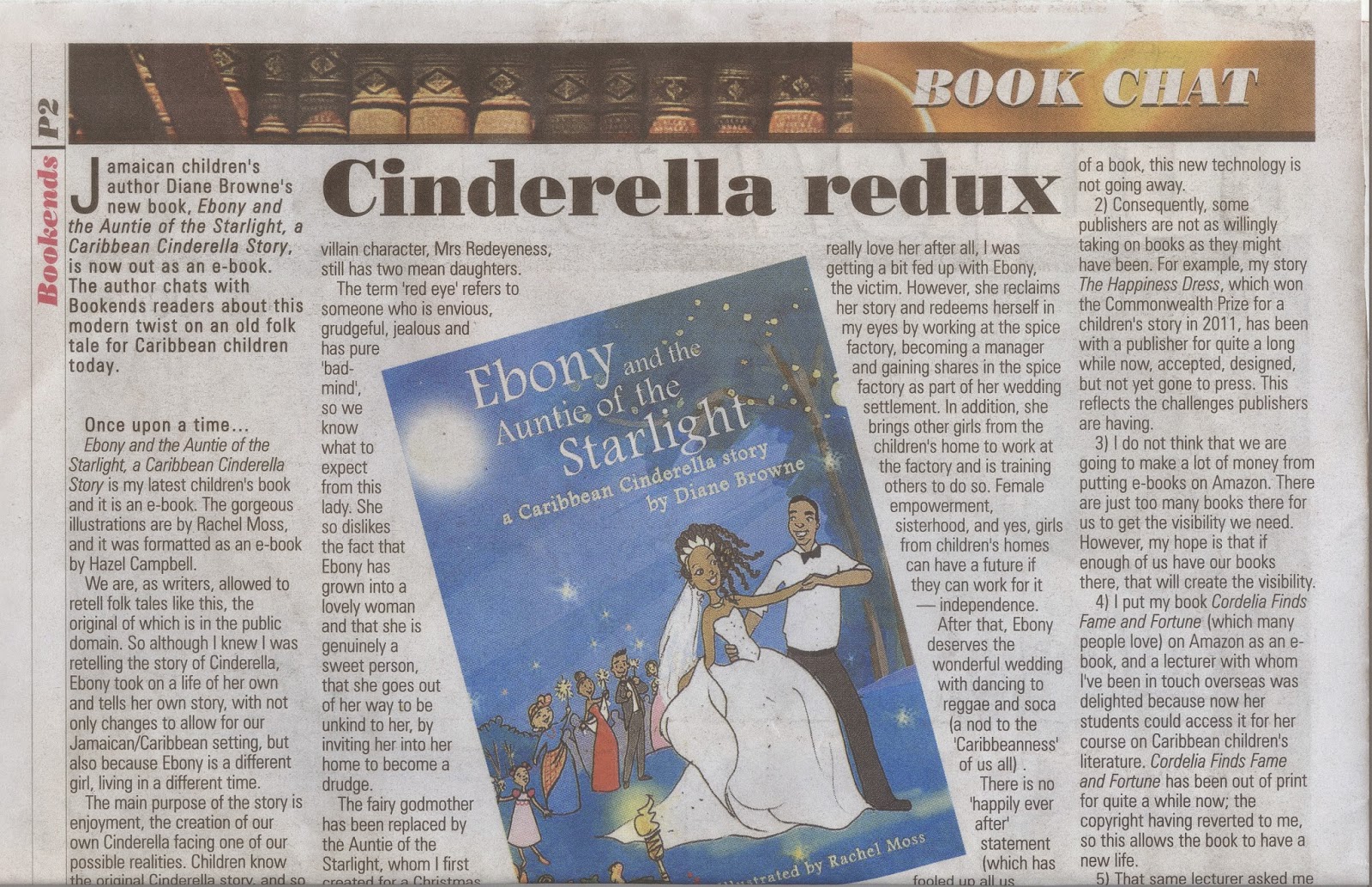
Bookends in The Sunday Observer of August 10, carried a piece by me on Ebony and the Auntie of the Starlight, a Caribbean Cinderella story. The content  was much like my blog of August 6, for those who want to see the local elements I introduced into the story.

The piece in the newspaper got me to thinking about folktales, the desire to rewrite some in our own image, the recording/rewriting  of our own.  There are many Cinderella stories, most, it would seem, originating from the societies in which they are located. Amazon has a  number of them,  including another Caribbean Cinderella by Robert Sans Souci (wonderful artwork), which I think is set in the French speaking Caribbean. I have not read it recently, and regrettably, do not own a copy.

When I was doing my MEd. research (not that long ago) I found that the teachers I interviewed had not been exposed to many Jamaican/Caribbean children’s books, which was distressing, but not that surprising. Interesting however, was one teacher’s response to my question about what she perceived to be our cultural heritage of children’s stories/material ( as well as Anancy). She said that Bible stories were part of our heritage because that’s what we grew up with, and so were traditional European fairy tales/folktales, for the same reason. I know, many of you are cringing. However, perception is reality.

Consequently, this could be a case for rewriting some of the traditional folktales in 'our own image'.  Cynically, I suspect that any rewritten ones would  not catch on. What can compare with the folktale characters, renamed as the ‘Princesses’ by Disney, with massive marketing of everything that can possibly be connected to them?  I have  attached to this post  covers  from two books written by  author /illustrator, the late Fred Crump Jr. (American)  in the 1980s/1990s. They are traditional fairy tales  with Black characters for African American children. These are from my collection of children’s books. I wonder how well these books did; he wrote a number. I googled him and found that he had one called Ebonita and the Seven Boys (my Ebony and his Ebonita). And no, I did not read his Cinderella  when I was writing Ebony and the Auntie of the Starlight. I haven’t looked at it in years. Moreover, I never read anything similar to what I’m writing, at any given time.

We, as minorities/majorities, depending on where we live,  may wish to rewrite the traditional fairy tales/folktales in the hope that  some children will read them and be inspired to greater self confidence, or even be moved to rewrite some themselves (perhaps  modern ones with 'lego type' figures). However, I suspect that any such endeavour would  not meet with much success, except for the exercise itself.

Clearly, it would seem that writing our own folktales would be the best way to go. And indeed at a workshop I facilitated with an overseas YA writer earlier this year, it was suggested that we have so much folklore (and by extension, folklore figures)  that we can create all sorts of exciting stories waiting to be discovered. This sounds wonderfully simple.  The problem I see with this is that many of our folklore figures are extremely malevolent.  Here in Jamaica, rolling-calf with eyes as red as coals dragging his rattling  chain; three-foot horse, which even with that handicap, or perhaps because of it,  will surely catch you;  Ol  Hige, shedding her skin;  River Mumma, at whom you shouldn’t look because  she could drag you down into the river; these are not the stuff of delightful children’s stories. And these are only the ones from Jamaica. Some of them from other territories in the Caribbean are even more frightening; soucouyant,  a shape-shifting blood sucking creature, or douens without faces and feet turned backwards, who lure children into the forest, for them never to be seen again. I think that our folklore is still too threatening, too close to us. European folklore was no doubt just as terrifying; witches and dragons, and wolves and beasts, but over the years they have been sanitized, and are seen as being from a very distant past, with no ability to frighten us anymore. In addition, they seem to lend themselves to being overcome by knights in shining armour, brave woodcutters, clever children and magical kisses. I know of no story of ours where anybody has been able to overcome anything, because ours speak to the supernatural, which one cannot overcome without a priest/parson,  calling on the blood of Jesus,  or some other religious activity. And I’m not being at all flippant.

This leaves us with good old Anancy and his comrades in mischief/deceit, Brer Tiger, Brer Rabbit, Brer Alligator, and so on. I enjoyed Anancy stories as child; the week overcoming the oppressor. These served the slaves well. However,  Anancy was also not averse to tricking his wife and children. This trickster side of Anancy, this ‘samfie’ side, may well be out of place as we move forward. The first time I heard this proposed (some years ago) I was horrified. What! Our precious Anancy! Never! Now, I’m not too sure. Time for samfie to be over and done with as a national construct? Never mind, guys. Calm your fluttering hearts. Anancy will probably always be with us.

It is against this background that I created Auntie of the Starlight, and she makes her second appearance in Ebony and the Auntie of the Starlight, a Caribbean Cinderella story, as a benevolent ‘fairy godmother’, although one that is somewhat annoyed with  silliness, like you not realising your worth. I must also point out that Helen Williams, (Bill Elm) made wonderful use of River Mumma in Delroy in the Marog Kingdom (Macmillan). Note however, that that book  is for an older child, and not for the Cinderella/Snow White generation. (Yes, I know the Cinderella story has lent itself to teenage movies, but you guys, know I’m not talking about that.)

I’d love to get feedback on this, the use of our own creatures/folklore in stories for younger children. I plan to follow this post with others on multicultural children’s literature, so we might find a connection. There have been recent  articles on this topic of children needing to see themselves in books, by Malorie Blackman in the UK and  the late Walter Dean Myers (USA) and his son.