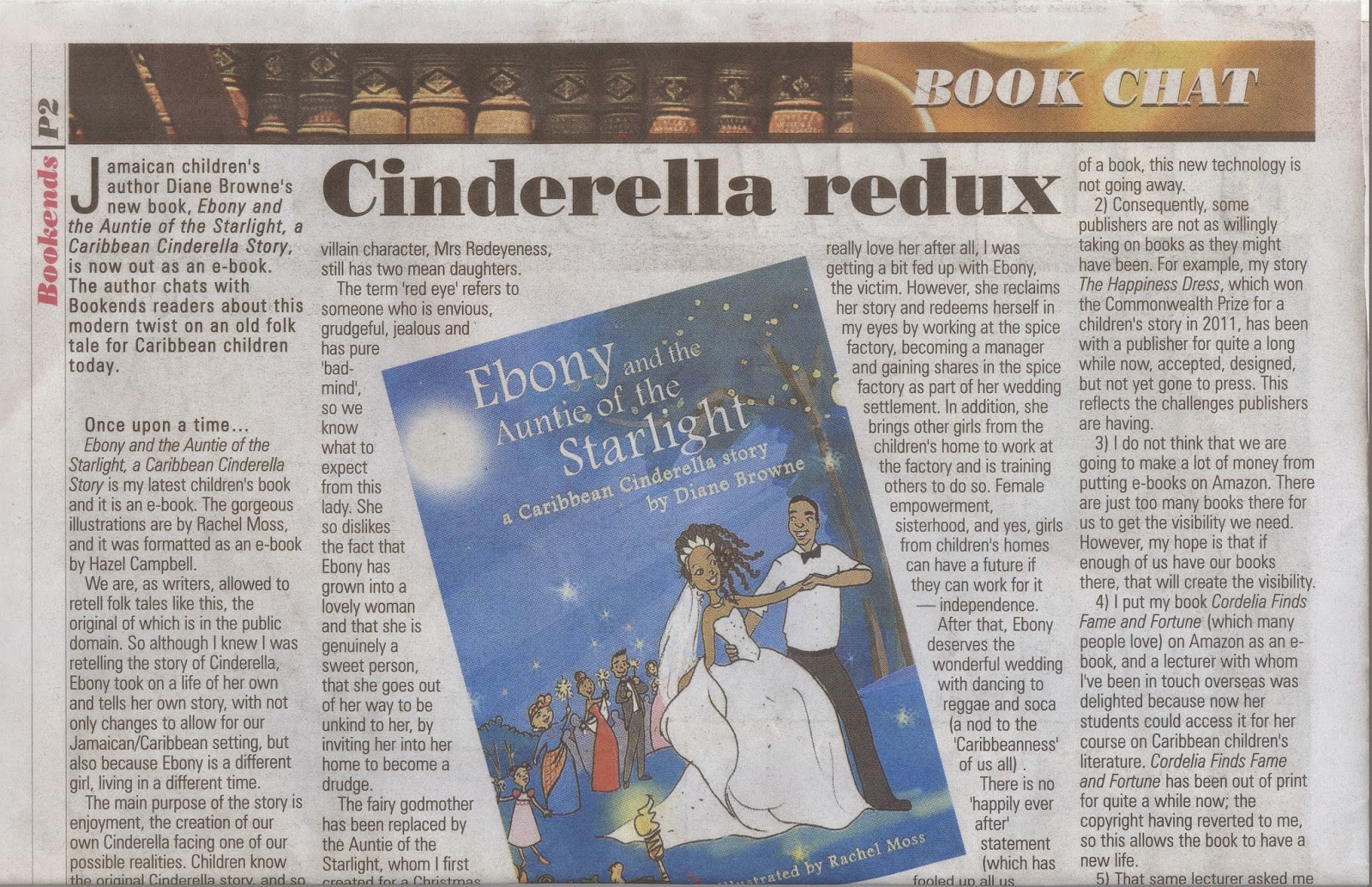
Bookends in The Sunday Observer of August 10, carried a piece by me on Ebony and the Auntie of the
Starlight, a Caribbean Cinderella story. The content was much like my blog of August 6, for those who want to see the local elements I introduced into the story.
The piece in the newspaper got me to thinking about folktales,
the desire to rewrite some in our own image, the recording/rewriting of our own.
There are many Cinderella stories, most, it would seem, originating from
the societies in which they are located. Amazon has a number of them, including another Caribbean Cinderella by
Robert Sans Souci (wonderful artwork), which I think is set in the French speaking
Caribbean. I have not read it recently, and regrettably, do not own a copy.
When I was doing my MEd. research (not that long ago) I found
that the teachers I interviewed had not been exposed to many Jamaican/Caribbean
children’s books, which was distressing, but not that surprising. Interesting
however, was one teacher’s response to my question about what she perceived to
be our cultural heritage of children’s stories/material ( as well as Anancy).
She said that Bible stories were part of our heritage because that’s what we
grew up with, and so were traditional European fairy tales/folktales, for the same reason. I know,
many of you are cringing. However, perception is reality.
Consequently, this could be a case for rewriting some of the traditional
folktales in 'our own image'. Cynically, I
suspect that any rewritten ones would not catch on. What can compare with the
folktale characters, renamed as the ‘Princesses’ by Disney, with massive
marketing of everything that can possibly be connected to them? I have
attached to this post covers from two books written by author /illustrator, the late Fred Crump Jr. (American)
in the 1980s/1990s. They are traditional
fairy tales with Black characters for
African American children. These are from my collection of children’s books. I
wonder how well these books did; he wrote a number. I googled him and found
that he had one called Ebonita and the Seven Boys (my Ebony and his Ebonita). And
no, I did not read his Cinderella when I
was writing Ebony and the Auntie of the Starlight. I haven’t looked at it in
years. Moreover, I never read anything similar to what I’m writing, at any
given time.

We, as minorities/majorities, depending on where we live, may wish to rewrite the traditional fairy tales/folktales
in the hope that some children will read
them and be inspired to greater self confidence, or even be moved to rewrite
some themselves (perhaps modern ones with 'lego type' figures). However, I suspect that any such endeavour would not meet with much success, except for the exercise itself.

Clearly, it would seem that writing our own folktales would be the best
way to go. And indeed at a workshop I facilitated with an overseas YA writer
earlier this year, it was suggested that we have so much folklore (and by
extension, folklore figures) that we can
create all sorts of exciting stories waiting to be discovered. This sounds wonderfully simple. The problem I see with this is that many of
our folklore figures are extremely malevolent. Here
in Jamaica, rolling-calf with eyes as red as coals dragging his rattling chain; three-foot horse, which even with that handicap,
or perhaps because of it, will surely
catch you; Ol Hige, shedding her skin; River Mumma, at whom you shouldn’t look because she could drag you down into the river; these are
not the stuff of delightful children’s stories. And these are only the ones from
Jamaica. Some of them from other territories in the Caribbean are even more frightening; soucouyant, a shape-shifting blood sucking creature, or
douens without faces and feet turned backwards, who lure children into the
forest, for them never to be seen again. I think that our folklore is still too
threatening, too close to us. European folklore was no doubt just as terrifying;
witches and dragons, and wolves and beasts, but over the years they have been
sanitized, and are seen as being from a very distant past, with no ability to
frighten us anymore. In addition, they seem to lend themselves to being overcome by
knights in shining armour, brave woodcutters, clever children and magical kisses. I know of no story of ours
where anybody has been able to overcome anything, because ours speak to the
supernatural, which one cannot overcome without a priest/parson, calling on the blood of Jesus, or some other religious activity. And I’m not
being at all flippant.
This leaves us with good old Anancy and his comrades in
mischief/deceit, Brer Tiger, Brer Rabbit, Brer Alligator, and so on. I enjoyed
Anancy stories as child; the week overcoming the oppressor. These served the
slaves well. However, Anancy was also not
averse to tricking his wife and children. This trickster side of Anancy, this ‘samfie’
side, may well be out of place as we move forward. The first time I heard this
proposed (some years ago) I was horrified. What! Our precious Anancy! Never!
Now, I’m not too sure. Time for samfie to be over and done with as a national construct?
Never mind, guys. Calm your fluttering hearts. Anancy will probably always be
with us.
It is against this background that I created Auntie of the
Starlight, and she makes her second appearance in Ebony and the Auntie of the Starlight, a Caribbean Cinderella story,
as a benevolent ‘fairy godmother’, although one that is somewhat annoyed with silliness, like you not realising your worth.
I must also point out that Helen Williams, (Bill Elm) made wonderful use of
River Mumma in Delroy in the Marog Kingdom (Macmillan). Note however, that
that book is for an older child,
and not for the Cinderella/Snow White generation. (Yes, I know the Cinderella
story has lent itself to teenage movies, but you guys, know I’m not talking
about that.)
I’d love to get feedback on this, the use of our own
creatures/folklore in stories for younger children. I plan to follow this post
with others on multicultural children’s literature, so we might find a connection. There have been recent articles on this topic of children needing to see themselves in books, by Malorie Blackman in the UK
and the late Walter Dean Myers (USA) and
his son.


