Showing posts with label Black Cinderella. Show all posts

Saturday, August 1, 2015

Response to a critic re my story Ebony and the Auntie of the Starlight a Caribbean Cinderella: symbolism and sensitivities


I posted a promo about Ebony and the Auntie of the Starlight, a Caribbean Cinderella story, on Facebook. I must admit it was not the most brilliantly written promo. It referred to Ebony being in a children’s home and having no future. This critic took me to task, asking how would children from children’s homes feel should they read that. I replied giving the exact words from the text (which she had not yet read). Ebony concludes, ‘People say that children from children’s homes have no future.’  I explained that I had very carefully thought about placing Ebony in a children’s home, and that eventually when Ebony comes into her own, (becomes a manager at the spice factory), she invites other girls from the children’s home to work at the factory and she trains them. Independence for Ebony and for the other girls as well! I thanked her very much for being interested enough to want to comment and to take the time to do so, and said.
 I welcome the challenge posed by the pitfalls of relevant material for our children, as all our local writers do. If this book, even though it is fantasy, makes people think more about the children in children's homes, realise they are of great value (in that we are all valuable, our lives are valuable, no matter where we come from or how we got here), and full of promise, then it will have accomplished something.
 I hoped that when she read the story she would let me know if/ how well the creating of this Caribbean Cinderella story works.
Some  things stand out.
1.    One should write well thought out promos.
2.    If a foreigner had written about children’s homes in a children’s book, no one would mind or even notice. Of course, foreign places are very big; the children’s home could be anywhere in the foreign land, so it never becomes personal or painful. 
3.    Yet, it is good that people notice. And this is why I say  that  writers of children’s stories in small developing nations, especially post colonial countries, have a great responsibility. Some people think writing a children’s book, is no big thing. Not true, guys. A good children’s book must entertain, but the writer must also be aware of the sensitivities of the society in which the story is set, and consequently, the values embedded in the story. Stories are never value free. Yet one must never appear to be preaching as that spoils the story.  

So I want to use this post to talk about the thought processes that went into this story. Many of them will not be evident to our child or adult readers, but they are important nonetheless, because they may stay with the reader long after the story has been read. 

1.    I wanted to write a story in which the Auntie of the Starlight would again play a role. She first appeared in a Christmas story, “Once Upon a Starlight”, written by me and published in a book “Big River and Other Stories”  by the Children Writers Circle. In response to my wish, she requested to appear in this Cinderella rewrite.

2.    The Cinderella character is called Ebony, to indicate a consciousness and celebration of our colour, and because I like Ebony trees when they bloom and promise rain. (Ebony trees appear in other children’s stories of mine.)

3.    It was a deliberate decision to place her in a children’s home. I didn’t think the term 'orphanage' would have much meaning to our children, but children’s homes tend to be in the news from time to time. They are perceived by many as a place of last resort for children. This is not necessarily so, but there is the perception that there is no future there. The story then sets out to show that there can be a future. And note,  Ebony is not ill-treated in the children’s home.

4.   The stepmother character is replaced by Mrs. Redeyeness (‘red eye’ being a term for envy in Jamaica). Mrs. Redeyeness, who lives near to the children’s home, takes pity on Ebony, and invites her to her home to play with her daughters. She does this only to impress people that she is kindhearted. The stepsister characters are Mrs. Redeyeness’ two daughters; not wicked, just spoilt and indulged. They are not really ugly, but their mean-spirited thoughts show on their faces, making them appear ugly. (Perhaps a warning to tell children this can happen. Oh, yes, it can. A cautionary tale?)

5.    I make Ebony into our version of the fairy tale princess.
 
And then Ebony began to grow into a young woman.    . . . her eyes,  were  big and brown and beautiful like burnt sugar in her face, which was the colour of rich chocolate. Her black hair had grown long over the years. She combed it with scented oils into six plaits, then she put the plaits up and secured them with the tortoiseshell clip. The clip flashed like magic in the sunshine, and the plaits fell like a spray of palm leaves all around her head.  . . . when she smiled it made people feel happy, as if gentle breezes were blowing.

6.    Mrs. Redeyeness now shows her true colours.
 
  Mrs. Redeyeness was overcome with envy that Ebony had become a beautiful girl and the envy turned to boiling anger. (Of course, people like that exist.)

      So Mrs. Redeyeness invites to Ebony to come and live with her. Ebony, feeling she has no future, goes.  Mrs. Redeyeness hates her for her beauty and kind nature, and hopes that she can hide her away from the world in the back of her house. ( Why? Pure bad mind! There are people like that. Wolf in sheep’s clothing.)
 

7.     Ebony becomes a drudge. Since there is no electricity in that part of the house ( surprise, surprise!) Ebony has to use all sorts of old-time Jamaican things - old time iron wood burning stove, coconut brush, sad irons and coal stove. (Chance for the children to hear about these things. And this does happen, you know. Decent kind-hearted people are taken advantage of, and some have so little self-confidence that they are complicit in their own sacrifice. Females who have been programmed to be nice have to take note of this.)

Mrs. Redeyeness is delighted that Ebony, who has no time to even comb her hair, is looking . . .a bit bedraggled. (Every now and then I like to use a word which is not one children will easily come across, but it’s so suitable. Bedraggled is one of those.)

Mrs. Redeyeness cackled to herself every time she looked at Ebony. "How bedraggled she looks. Ha! Ha! Bedraggled! Ha! Ha!”

8.   ( However, by this time, dear readers, I’ve just had about enough of Miss Ebony. I’m fed up with her. I can’t believe that she could be so ‘fool’. Can anything save her? I seriously consider not going any further with the story. I suspect that it is only Mr. Redeyeness’ malice, as shown in that excerpt, that forces me to continue the story.)

9.  Ebony, does not need a ball to meet her ‘prince’. Instead, there is going to be a parade for Independence. The parade is sponsored by the spice factory in the district. The heir to the spice factory has come home from his studies and everybody concludes that he will need a wife. All mothers get in gear. Everybody dressing up for the parade! The ‘ugly sisters get their costumes made by a dancehall  tailor. Ebony is sewing hers by hand. The sisters steal it and cut it up. They look even more ugly after doing this dastardly deed.

10.  Mrs. Redeyness, to make sure that Ebony cannot reach the parade, gives her a long list of Jamaican foods to prepare, (every Jamaican food you can think of and love, saltfish and ackee, bammies, fried dumplings, curry goat, jerk pork, etc.) No way she can finish in time to go to the parade.

11.  However, a starlight left on a windowsill where Ebony is cooling food, falls into the coal pot. And out of the wonderful starlight display, steps the Auntie of the Starlight. She is clearly as fed up with Ebony as I am, as she says, 

I was wondering how long it would take you to see that these people taking advantage of you.

     The Auntie of the Starlight gives Ebony three wishes ( of course) and sings a song with a lot of the names of Jamaican trees, as she works her magic:

 Mahoe, logwood, cedar, lignum vitae, mahogany, ebony,
Trees of the land of wood and water
Grant this wonderful wish to this daughter . . . 

12.  Ebony gets to go to the parade in a beautiful dress, but without glass slippers - not needed in the Caribbean. And no, she doesn’t need a coach either, or any of those things from the old fairy tale. Everybody is dancing: 

Dance to the Independence beat
Move your feet, . . .

 Along comes the parade with people dressed up as Jamaican spices, with the Spice Prince (Alfred) himself travelling on one of the floats. He sees Ebony and stops the parade! Everybody is in shock. He is attracted by her beauty, and her kindness and goodness, which he can see in her smile (at last her goodness begins to pay off).

13.   Mrs. Redeyeness, seeing that this could be a dangerous situation, invites them  back to her house, where she plies Alfred with all the various foods cooked by Ebony, and implies  that her daughters have cooked them. Alfred soon uncovers that lie, and  asks for Ebony’s hand in marriage, in spite of Mrs. Redeyeness shouting that Ebony has no family and is nobody. Alfred, seems to feel that one can make one’s future even if you don’t have great family credentials.  (Chalk one more point up for the inhabitants of children’s homes.)

14.   At this point Mrs. Redeyeness and her daughters throw themselves upon Ebony declaring their love, saying they cannot do without her. And for a moment Ebony wonders if they really, really love her. (I am in despair of her yet again, wondering if this silly girl is really going to believe them. This can happen, you see, if you’ve never been loved and feel a bit insecure.)

15.   She comes to her senses, however, and goes off to work for the ‘spice prince’ at the spice factory. Where does she live? Oh, it’s all very proper. She lives with his parents. He doesn’t live there. He has his own place (modern times). Soon she becomes a manager. She brings other young women from the children’s home to work there and trains them. As part of her wedding present she gets shares in the business.  (Now this is big time! Even I wouldn’t think of that. Independence! This is a totally modern girl. I worried if this might seem as if she was a gold digger, but I realized that she was just recognising her full worth to the business. And after all, Alfred offers them.)

Ebony has a lovely wedding with everybody there from the district and the children’s home, and the Auntie of the Starlight. Ebony and her Alfred dance the night away in true Caribbean fashion.  

So on this wonderful night, Ebony hitched the train of her wedding dress over her arm, and extended her other arm as she danced, sway, sway, sway, shuffle, shuffle, shuffle,  yo, yo, yo across the floor. And the Spice Prince took off his jacket and rolled his sleeves halfway up his arms and danced around her, sway, sway, sway, shuffle, shuffle, shuffle, yo, yo, yo.


Lovely illustration by Rachel Moss that so captures it.

You can still buy the book, if even just to find out if we do indeed discover who Ebony may be,  what her three wishes are, and if they come true, but hopefully, to enjoy the story, and tell me if the Caribbean flavour and the symbolism works.

Amazon link: http://www.amazon.com/Ebony-Auntie-Starlight-Caribbean-Cinderella-ebook/dp/B00M7CY050



Sunday, September 7, 2014

Whose folktale is it anyway?


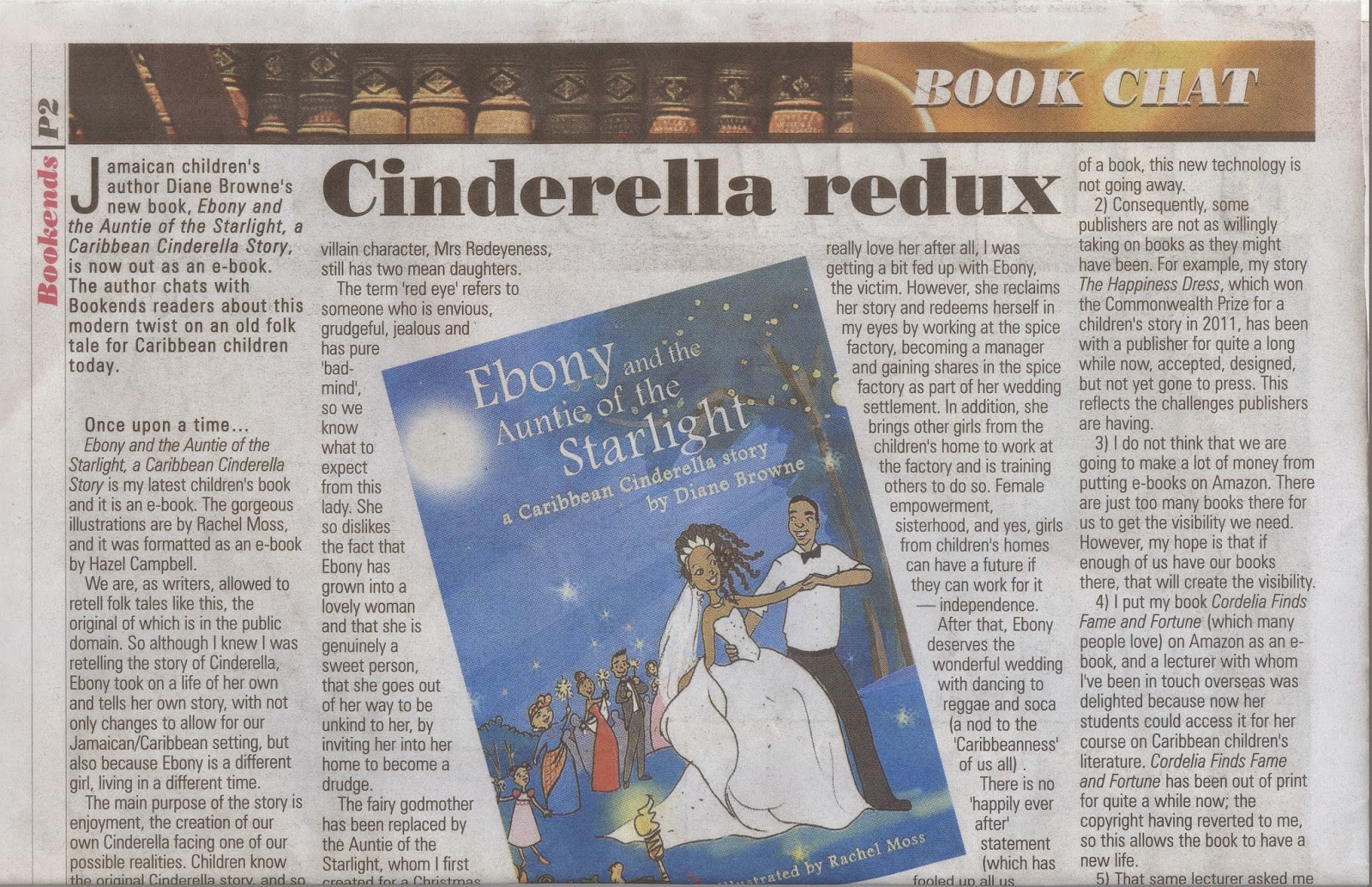
Bookends in The Sunday Observer of August 10, carried a piece by me on Ebony and the Auntie of the Starlight, a Caribbean Cinderella story. The content  was much like my blog of August 6, for those who want to see the local elements I introduced into the story.

The piece in the newspaper got me to thinking about folktales, the desire to rewrite some in our own image, the recording/rewriting  of our own.  There are many Cinderella stories, most, it would seem, originating from the societies in which they are located. Amazon has a  number of them,  including another Caribbean Cinderella by Robert Sans Souci (wonderful artwork), which I think is set in the French speaking Caribbean. I have not read it recently, and regrettably, do not own a copy.

When I was doing my MEd. research (not that long ago) I found that the teachers I interviewed had not been exposed to many Jamaican/Caribbean children’s books, which was distressing, but not that surprising. Interesting however, was one teacher’s response to my question about what she perceived to be our cultural heritage of children’s stories/material ( as well as Anancy). She said that Bible stories were part of our heritage because that’s what we grew up with, and so were traditional European fairy tales/folktales, for the same reason. I know, many of you are cringing. However, perception is reality.

Consequently, this could be a case for rewriting some of the traditional folktales in 'our own image'.  Cynically, I suspect that any rewritten ones would  not catch on. What can compare with the folktale characters, renamed as the ‘Princesses’ by Disney, with massive marketing of everything that can possibly be connected to them?  I have  attached to this post  covers  from two books written by  author /illustrator, the late Fred Crump Jr. (American)  in the 1980s/1990s. They are traditional fairy tales  with Black characters for African American children. These are from my collection of children’s books. I wonder how well these books did; he wrote a number. I googled him and found that he had one called Ebonita and the Seven Boys (my Ebony and his Ebonita). And no, I did not read his Cinderella  when I was writing Ebony and the Auntie of the Starlight. I haven’t looked at it in years. Moreover, I never read anything similar to what I’m writing, at any given time.

We, as minorities/majorities, depending on where we live,  may wish to rewrite the traditional fairy tales/folktales in the hope that  some children will read them and be inspired to greater self confidence, or even be moved to rewrite some themselves (perhaps  modern ones with 'lego type' figures). However, I suspect that any such endeavour would  not meet with much success, except for the exercise itself.

Clearly, it would seem that writing our own folktales would be the best way to go. And indeed at a workshop I facilitated with an overseas YA writer earlier this year, it was suggested that we have so much folklore (and by extension, folklore figures)  that we can create all sorts of exciting stories waiting to be discovered. This sounds wonderfully simple.  The problem I see with this is that many of our folklore figures are extremely malevolent.  Here in Jamaica, rolling-calf with eyes as red as coals dragging his rattling  chain; three-foot horse, which even with that handicap, or perhaps because of it,  will surely catch you;  Ol  Hige, shedding her skin;  River Mumma, at whom you shouldn’t look because  she could drag you down into the river; these are not the stuff of delightful children’s stories. And these are only the ones from Jamaica. Some of them from other territories in the Caribbean are even more frightening; soucouyant,  a shape-shifting blood sucking creature, or douens without faces and feet turned backwards, who lure children into the forest, for them never to be seen again. I think that our folklore is still too threatening, too close to us. European folklore was no doubt just as terrifying; witches and dragons, and wolves and beasts, but over the years they have been sanitized, and are seen as being from a very distant past, with no ability to frighten us anymore. In addition, they seem to lend themselves to being overcome by knights in shining armour, brave woodcutters, clever children and magical kisses. I know of no story of ours where anybody has been able to overcome anything, because ours speak to the supernatural, which one cannot overcome without a priest/parson,  calling on the blood of Jesus,  or some other religious activity. And I’m not being at all flippant.

This leaves us with good old Anancy and his comrades in mischief/deceit, Brer Tiger, Brer Rabbit, Brer Alligator, and so on. I enjoyed Anancy stories as child; the week overcoming the oppressor. These served the slaves well. However,  Anancy was also not averse to tricking his wife and children. This trickster side of Anancy, this ‘samfie’ side, may well be out of place as we move forward. The first time I heard this proposed (some years ago) I was horrified. What! Our precious Anancy! Never! Now, I’m not too sure. Time for samfie to be over and done with as a national construct? Never mind, guys. Calm your fluttering hearts. Anancy will probably always be with us.

It is against this background that I created Auntie of the Starlight, and she makes her second appearance in Ebony and the Auntie of the Starlight, a Caribbean Cinderella story, as a benevolent ‘fairy godmother’, although one that is somewhat annoyed with  silliness, like you not realising your worth. I must also point out that Helen Williams, (Bill Elm) made wonderful use of River Mumma in Delroy in the Marog Kingdom (Macmillan). Note however, that that book  is for an older child, and not for the Cinderella/Snow White generation. (Yes, I know the Cinderella story has lent itself to teenage movies, but you guys, know I’m not talking about that.)

I’d love to get feedback on this, the use of our own creatures/folklore in stories for younger children. I plan to follow this post with others on multicultural children’s literature, so we might find a connection. There have been recent  articles on this topic of children needing to see themselves in books, by Malorie Blackman in the UK and  the late Walter Dean Myers (USA) and his son.

Monday, August 18, 2014

Despatches: A successful upload; another endeavour disappointing: Rethinking endeavours; to do or not to do


Now why should you read this post? It may be much ado about nothing. Aha, maybe that’s why you should read it; in case it isn’t.

Successful upload. As you know (those who may follow my blog) Ebony and the Auntie of the Starlight, a Caribbean Cinderella story was uploaded to Amazon. Then  on Sunday, August 10, the Observer newspaper highlighted it in Bookends. I was very pleased.


Disappointment: I saw the PDF of Things I Like. I did not like my painting of the illustrations at all. At all! They looked lovely when I painted them, even when I put them on my blog, but stand alone in a book. No sir! I saw every miss-stroke of the brush, every distortion of an image.  The idea was to  produce the PDF  and get a corporate sponsor for copies for basic schools. Well, I’d be embarrassed to own these images. My designer did  her best. I was so overwhelmed (not to tears, or anything like that), just so astonished, that all I could say to her, is ‘stop there while I think about this’.
There are lessons to be learnt here.
1.       A Level Art does not make you an artist or illustrator.
2.       Four hours of painting lessons year before last, does not get you back to A Level standard, which does not  . . . anyway.
3.       There is a reason why they have illustrators for children’s books.
4.      You may never be able to turn yourself into a painter or illustrator for your own books. Accept that!

So what do I do now?
1.       Clearly I should ask my designer if she can just colour the pictures with Photoshop or something.
2.       Give up the idea of the book and feel ‘pale and wan’ (check the literature we read in school for explanation of the term) about any such endeavour.
3.       Perhaps ask about new illustrations for the text. What a frantic thought!

Well, clearly, I’ll go with #1 first. The fact that I have not done it yet speaks volumes although I cannot hear what is being said.
This post would seem to be all about my angst; much ado about nothing, indeed. However I think it speaks to some very important concerns, none of them new,  but the ability to self-publish underscores them.
The most important is how do you get the money to self-publish what you want to publish, or in my case, republish? People have been asking me why I don’t seek crowdfunding. To show how up-to-date I am on the concept,  I was about to write 'cloud funding' (naturally, things are stored in a cloud, so clearly, .  .  .  ) when a little voice said, “Look it up!”  Eh! Eh! But is a whole world out there of crowdfunding. So many sites. I would of course be shy/too proud/can’t wrap my head around the concept of people I don’t know supporting me, and on and on into further  angst.

I think one of my biggest challenges right now is do I want to continue to try to  break these new barriers, of this new digital  world, and I really hate this being in the spotlight of doing things, doing them differently (no doubt, that is why I write a blog, eh!), or do I want to retreat into the dignity of the ‘pure writer’ who must always be published by a well know publisher to be considered to be a serious, pure, mature writer? To do or not to do; to be or not to be.
This is a case of pure confusion. I’m going to put it down and come back to it another time. Any ideas would be welcome, guys! 

Next post will be about more mature matters.

Wednesday, August 6, 2014

And independent Caribbean Cinderella for Independence, as promised


 Ebony  and the Auntie of the Starlight, a Caribbean Cinderella story has made it for Independence, August 6. In fact, she was up and ready for Emancipation Day.  The significance of Independence was that instead of Ebony meeting the prince at a ball, she meets him at the Independence Parade.  I do not know if there is any symbolism in Emancipation. I would not ascribe such links between the story and the symbolism  of Emancipation Day. It might even seem somewhat disrespectful. However, in all seriousness, there is the emancipation from mental slavery that Bob Marley sang about.
I have  sent out notices to all the people in my address book, which you guys know I hate, because it seems so pushy, so I’m glad that’s over. I have to develop a better marketing strategy. For one, very few people on my list will buy the book as an e-book. We are not into e-books yet for children.  For two, it’s not a targeted group. Many of the people on my list may not even be interested in children’s books.  
So come with me as we step awhile into the creation of Ebony  as a Caribbean Cinderella.

Differences/Similarities:
Differences and similarities are interwoven; they go in and out like maypole dancers (which are both European and part of our Jamaican heritage, as you may remember).
First, Ebony is in the Caribbean, and is an orphan in a children’s home, not related to the stepmother figure/villain figure as in the original fairy tale. However, the evil villain character, Mrs. Redeyeness still has two  mean daughters.
The fairy godmother has been replaced by the Auntie of the Starlight, and her transforming of Ebony from the kitchen to the parade, mirrors Cinderella, even as it creates humour at what is different. Ebony it seems, remembers the Cinderella story,  and wonders if the steps to her transformation will be the same. ( I love to do this by way of showing that the old folktales can make links with our stories today. I did it in Cordelia Finds Fame and Fortune, but just a mention.) So back to Ebony.

“Oh, Auntie of the Starlight, thank you, thank you!” she cried. “But are you sure I can walk in glass slippers?”  

“They aren’t glass, chile. Everybody knows glass would break,” said the Auntie of the Starlight. “I don’t know where you get that idea of glass slippers. Pure foolishness! They are plastic.” 

“Oh,” said Ebony, “I thought I heard it in a story. So should I have a coach made from a pumpkin? Or maybe not. . .” 

“A coach! No! What would you do with a coach? If you wished for a car. . .  but you didn’t,” said the Auntie of the Starlight. “So run, chile! Run and catch the parade before it pass.”  
 

The prince is not a prince, but the son of the owner of a spice factory called the Spice Kingdom,  therefore  prince-like as far as the people in the district are concerned. 

 Symbolism and Character in the Story:
Ebony is an orphan in a children’s home. This beginning has never been auspicious for anyone anywhere. Ebony rightly concludes she has no future. This is what she has to overcome in the story,  if she can.  I clearly describe Ebony’s physical  appearance and hair (that which we do not wish to mention) as  celebration of the African part of us.
Mrs. Redeyeness: the fact that she is not related to Ebony by marriage makes her behaviour all the more dreadful. The term ‘red eye’ refers to someone who is envious, grudgeful, jealous and has pure 'bad mind'.  She so dislikes  the fact that Ebony has grown into a lovely woman and that she is genuinely a sweet person, that she goes out of her way to be unkind to her, by inviting her into her home to become a drudge.  See how Mrs. Redeyeness  rejoices as Ebony’s  beauty seems to fade under all the hard work she has to do:

 “Ebony will just look like a poor bedraggled butterfly.” Every time she thought of it, she laughed, “Ha ha! Ha ha! A bedraggled butterfly! Ha ha! Ha ha! A bedraggled butterfly!”
 

Auntie of the Starlight: we first see her in the Christmas story I wrote light years ago, which I usually put on my blog ever Christmas. I developed her in place of the traditional fairy godmother. Auntie is a term of respect here, and I love starlights, such excitement when I was a child.  Such magic. Perhaps she is also partly the wise old woman who features in our stories, mine included, the mother-female/the grandmother-female.

The song sung by the Auntie of the Starlight, celebrates our trees, links to the fact that Ebony’s name is that of a tree, and so perhaps that allows for extra magic; who knows? for additional help for this daughter of the island, daughter being a respectful term for a  young  woman. Perhaps I got the term from Rastafarian speech. I don’t know. Things seep into the psyche and reappear in stories.

The spices celebrate our spices, that I think we could really develop and access niche markets.

Alfred ‘the prince’ is noble and handsome and good, and sees who Ebony really is. He will respect her, we know. That is very important. His character rather than his position, indicates why Ebony could love him.

Plot: Aha! By the time I’d got to the part where Alfred  has done his ‘some day my prince will come’, asking for Ebony’s hand in marriage, and then Mrs. Redeyeness and daughters cling to Ebony, declaring their love and need for her, and Ebony is wondering if they really love her after all, and maybe she shouldn't leave them, I was pretty fed up with the ‘too-good’ Ebony.  She redeemed  herself in my eyes, however, by working at the spice factory, gaining shares in the spice factory as part of her wedding settlement, along with the ring. Mercenary? Not at all. Modern little girls need to know that a certain amount of security is important, especially when they work for it. In addition, she brought other girls from the orphanage to work there and was training others to do so. Female empowerment, sisterhood, and yes, girls from children’s homes can have a future if they can work for it - independence.
After that Ebony deserves the wonderful wedding with dancing to reggae and soca. ( a nod to the ‘Caribbeanness’ of us all) and in describing  the dancing, I chose words which to me give exactly that feeling, that movement of the feet and body.  . . . sway, sway, sway, shuffle, shuffle, shuffle  yo, yo yo . . . I hope that they succeeded.
There is no ‘happily ever after’  statement (which has fooled up all us females, all our lives) except that which Ebony can make with her life. “And Ebony realized that she had a bright future after all, and she smiled to think how happy she was.”  

Many of the old-time fairy tales/folktales were morality tales of a sort, warning tales, even if today they have been so sanitized and changed  that we have forgotten whatever that was about. Does Ebony and the Auntie of the Starlight have any  of these elements? Yes, although I did not set out for it to be so. I think that 1) the message (especially for ‘sweet people’) is do not let people take advantage of you, under the guise of love and affection, and 2) stand on your own two feet even when you think your prince has come.
The  main purpose of the story is enjoyment, the creation of our own Cinderella facing one of our possible realities.  Children know the original Cinderella story and so I hope they will also enjoy these differences, and claim this as their own. One does not expect them to understand the symbolism, but for our present-day girls, I hope the modern twist resonates with them as they are growing up.